
Connectivity Modules
G3-PLC Power Line Module
Microchip PL460 · Hybrid G3-PLC + RF · CENELEC B & FCC · Plug-in module
Communicate over existing power wiring — no new cabling, no RF spectrum, no interference. The same Host API works across all ARG comm modules: switch from Power Line to cellular or Wi-Fi with zero host firmware changes.
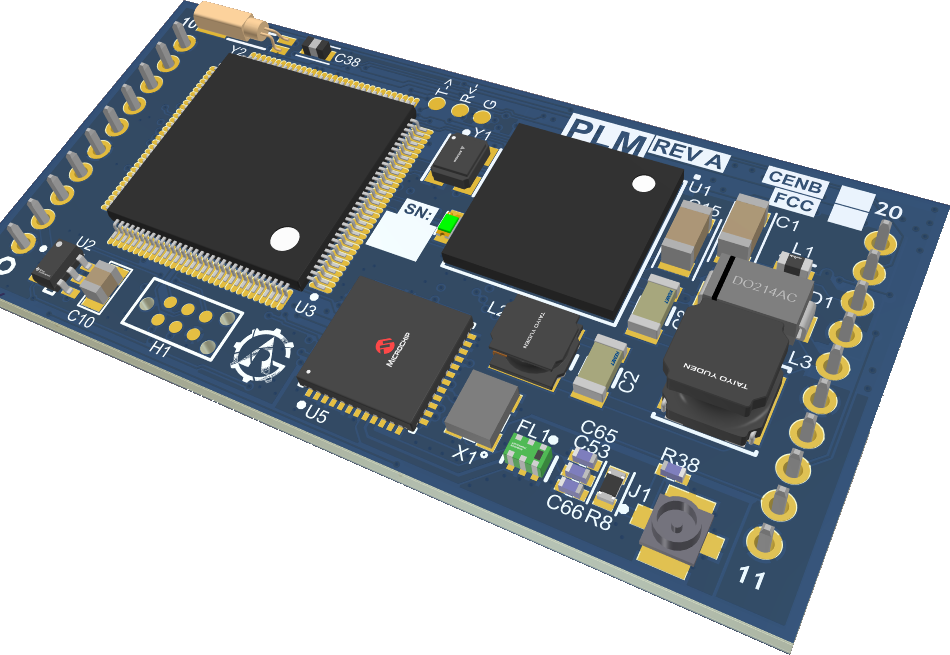
ARG Connectivity Modules
Hybrid power line + RF networking. No new wiring.
The ARG G3-PLC Module is built around the Microchip PL460 OFDM modem, running the G3-PLC standard on both the CENELEC B band (95–125 kHz, Europe) and the FCC band (154–488 kHz, North America). On top of the power-line link it runs the G3-Hybrid profile — a secondary sub-GHz RF radio (SUN FSK, IEEE 802.15.4) sharing one mesh — so every node is reachable over the wiring, over the air, or both, with the network taking the stronger path automatically. It operates over 80–305 VAC lines, supports up to 255 nodes per mesh with auto-commissioning and self-healing, and exposes the ARG Common Host API — the same UART binary interface used by every ARG comm module. Deployed in the iAQ-Pro-D HVAC monitor and GSB-01 gas sensor module.
Built on the Microchip PL460 — ARG is a Microchip Authorized Design Partner.
The ARG Comm Platform
One host board. Any connectivity.
ARG products are designed around a common comm module footprint and a hardware-agnostic Host API. The same host firmware runs unchanged whether the module inside is cellular, Wi-Fi, Power Line, or Modbus — decide connectivity at production time. (A Power Line build additionally needs the line-coupling network on the host board; the common part is the Host API and firmware, not the mains wiring.)
Same Form Factor
Samtec plug-in headers, common ARG module footprint. Every ARG comm module — cellular, Wi-Fi, Power Line, Modbus — fits the same pinout on the host PCB.
Same Host API
A single UART binary protocol — PUBLISH, STATUS_GET, RECEIVED — works identically across all module types. The host sends a payload and receives data without knowing the underlying medium.
Any Technology
Power Line where wiring exists. Cellular for remote field sites. Wi-Fi for campus deployments. Modbus for BMS integration. Select the module for each deployment — the Host API and host firmware stay the same.
OTA Firmware Updates
3.5MB NOR flash staging partition allows full over-the-air module firmware updates. The host streams the new image over UART; the modem validates, self-programs, and reboots autonomously.
Capabilities
G3-PLC networking over your existing infrastructure.
The Microchip PL460 runs the full G3-PLC stack on both the CENELEC B (Europe) and FCC (North America) bands, and the G3-Hybrid profile layers a secondary sub-GHz RF mesh on top. Where the power line is noisy, RF carries the traffic; where RF is blocked, the wiring does — one network, two media, no gaps.
Hybrid PLC + RF
The G3-Hybrid profile pairs the power-line link with a secondary sub-GHz RF radio (SUN FSK, IEEE 802.15.4-2020). Both media run one unified G3 mesh, so every node is reachable over the wiring, over the air, or both — redundant paths with no second network to manage.
Automatic Medium Selection
The mesh routes each hop over whichever medium is stronger — power line or RF — and re-routes across the two as conditions change. A noisy phase, a transformer boundary, or a blocked radio link never takes a node offline; the network moves the data path to the medium that works.
G3-PLC CENELEC B & FCC
Microchip PL460 OFDM modem. Runs the G3-PLC standard on the CENELEC B band (95–125 kHz) for Europe and the FCC band (154–488 kHz) for North America. Bi-directional data transfer between the power line and the host UART. Worldwide regulatory acceptance.
Self-Healing Mesh Network
Up to 255 nodes per network. Automatic network commissioning — nodes discover and join without manual configuration. Mesh auto-healing reroutes traffic around failed nodes automatically.
Private Network Security
Network PAN ID and private pre-shared key (PSK) prevent cross-network interference. Optional ECC 256-bit encryption for secure private network commissioning and end-to-end payload protection.
Wide AC Input Range
Operates over 80–305 VAC, 50/60 Hz — single and three phase. The AC input is capacitively coupled with an isolation transformer; no active power is consumed on the AC rail.
Specifications
| PLC Chipset | Microchip PL460 OFDM Power Line Modem |
|---|---|
| PLC Standard | G3-PLC — CENELEC B (95–125 kHz, Europe) & FCC (154–488 kHz, North America). Band selectable in firmware, but the host-board coupling passives fix the analog pass-band — the fitted C5 and the firmware band setting must agree. |
| RF (G3-Hybrid) | Secondary sub-GHz RF medium — SUN FSK per IEEE 802.15.4-2020, license-free ISM. Runs the same G3 mesh; nodes route over PLC, RF, or both, selected automatically per hop. |
| Modulation | OFDM (G3-PLC) |
| Data Rate | Up to ~40 kbps on CENELEC B; higher throughput on the wider FCC band |
| Line Voltage Range | 80 – 305 VAC, 50/60 Hz, single & three phase — via the host-board coupling network. The module itself has no mains connection. |
| Line Coupling | On host board (not on module) — capacitive coupling + isolation transformer; reference design and BOM supplied. Zero active power drawn from the AC line. |
| Network Size | Up to 255 nodes per network |
| Network Topology | Auto-commissioning mesh with auto-healing |
| Security | Network PAN ID + private PSK; optional ECC 256-bit encryption |
| 12V Power Rail | 12 V, 70–150 mA (analog front end) |
| 3.3V Power Rail | 3.25 – 3.35 V, 56–65 mA (digital section) |
| Digital IO | 3.3V UART (TX, RX), active-low reset, 2× digital outputs |
| Connector | Samtec plug-in headers, 0.38mm board-mount pins |
| Form Factor | 2.0″ × 1.0″ (50.8 × 25.4 mm) — common ARG module footprint |
| Storage Temperature | −40°C to +120°C |
| Operating Temperature | −40°C to +85°C |
| Protocol | ARG Binary Frame Protocol v0.1 |
|---|---|
| Physical | UART, 460,800 baud, 8N1, hardware flow control (RTS/CTS) |
| Signals | TX, RX, RTS, CTS, nRST, PWR_EN |
| Frame Format | SOF (0xAA) + VER + TYPE + LEN[2] + PAYLOAD[0–512] + CRC16-CCITT[2] |
| Max Frame | 519 bytes · Max payload: 512 bytes |
| CPU Burden | Zero — DMA + hardware flow control on both host and modem; CPU wakes only on complete frame |
| Compatibility | Protocol-identical across all ARG comm modules — cellular, Wi-Fi, G3-PLC, Modbus |
Frequently Asked
Power Line Communication — FAQ
Straight answers to the questions we hear most about power line communication and the ARG G3-PLC module.
What does the host board need to provide for the PLC coupling?
The module connects to the mains through a small coupling network on your host board — a band-setting film capacitor (C5, 470 nF for CENELEC B), a series inductor, a bidirectional TVS, and an isolation/matching transformer. That's roughly four parts and about $6 per node in standard distributor stock. Your board also supplies two DC rails: 12 V at 70–150 mA for the analog front end and 3.3 V at 56–65 mA for the digital section. The band is set by C5 plus a firmware setting — changing band (CENELEC B ↔ A ↔ FCC) is a capacitor swap on your board, not a different module part number. Keeping the mains-referenced parts on the host board also puts the creepage and clearance decisions on the board you certify. An evaluation carrier with the coupling network already fitted is available, and the reference schematic, module footprint, and mechanical drawing are supplied to integrators.
Is the module CE / EN 50065 certified?
It is designed to the EN 50065-1 CENELEC B conducted-emission limits, and the underlying Microchip PL460 / G3-PLC stack is used in certified smart-metering and building-automation equipment worldwide. Formal CE / EN 50065 certification is undertaken as part of a production programme, because conducted emissions in the CENELEC band are substantially a property of the finished assembly and its coupling network — not the module in isolation. ARG runs that certification path with you as part of the build.
Isn't power line communication an outdated technology?
No. PLC keeps evolving — modern standards such as G3-PLC and IEEE 1901.2 bring improved modulation, stronger security, and hybrid (PLC + RF) networking. It's a core layer in next-generation smart grids and industrial IoT, and increasingly a data backbone: it collects reliable data from distributed devices that AI and analytics platforms use for predictive maintenance, grid optimization, and anomaly detection.
Aren't power lines too noisy for reliable communication?
Power lines are noisy, but modern PLC is built for that environment. OFDM modulation, forward error correction (FEC), interleaving, and adaptive tone mapping keep communication robust even under severe noise.
Will PLC disturb my power supply or connected equipment?
No. PLC uses low-power, high-frequency signals superimposed on the line — negligible next to the power itself. They're designed to coexist with power delivery, are filtered and coupled to avoid affecting equipment, and comply with EMC standards. A properly designed PLC system doesn't affect power quality or supply stability.
Isn't PLC too slow, suitable only for low data rates?
PLC isn't inherently slow — it's tuned to the application. Narrowband PLC runs from kb/s to hundreds of kb/s, mid-band reaches Mb/s, and broadband up to roughly 1 Gb/s. Standards like G3-PLC and IEEE 1901.2 deliver hundreds of kb/s — plenty for advanced metering, firmware updates, and real-time grid control, where determinism matters more than peak throughput.
Isn't wireless always the better choice?
Not for systems already connected to power. Wireless wins on mobility, but PLC offers deterministic coverage — any device on the line can be reached — without coverage gaps, spectrum congestion, or dependence on external infrastructure. The two are complementary: the G3-PLC module pairs naturally with a cellular or Wi-Fi backhaul.
Can I just use a wireless modem on the power line?
No. The power-line channel is fundamentally different from RF — periodic noise synced to the AC cycle, frequency-selective attenuation, impedance swings, and impulse noise from motors, relays, and switching. Reliable PLC needs a PHY layer purpose-built for that channel, not a wireless modem adapted to it.
Is PLC only useful for smart meters?
Metering (AMI) is common, but PLC also serves street lighting, industrial automation, EV charging, transportation, and renewable energy. Modern narrowband PLC supports IPv6 (6LoWPAN), mesh routing, and strong security, making it a general-purpose technology for large-scale, mission-critical infrastructure.
Is PLC secure?
Yes. Modern PLC standards include AES encryption (128/256-bit), authentication, secure key management, and controlled device provisioning. As a wired medium it also avoids over-the-air exposure, requires physical access to tap, and reduces the risk of jamming, spoofing, or RF-based attacks — a strong fit for critical infrastructure.
Is PLC difficult to deploy?
Usually the opposite. PLC reuses existing electrical wiring — no trenching, no new cable runs, no wireless site surveys or spectrum planning. With minimal added hardware, deployment is faster and total cost is lower.
Does PLC scale to large deployments?
Yes — up to millions of nodes across mesh and hierarchical topologies with utility-grade management. ARG's G3-PLC (ITU-T G.9903, CENELEC-B / FCC) supports 255 nodes per cluster with roughly 3-mile range over existing wiring, and clusters combine for wider coverage.
Is PLC future-proof?
PLC is becoming core to long-term grid architecture. Modern standards (G3-PLC, IEEE 1901.2) are IPv6-based (6LoWPAN), built for interoperability and long lifecycles, and still evolving toward hybrid PLC+RF and higher performance. PLC networks already support DER integration, EV charging, and AI-driven grid analytics.
Adapted from “11 Myths About Power Line Communication (PLC)” by Zeev Collin, Semitech Semiconductor — Electronic Design, July 2026.
Ready to add power line networking to your design?
Get pricing for the G3-PLC module, volume orders, and custom integration support.