
Industrial Edge
DC3 Industrial Edge Gateway
Cellular · Wi-Fi · G3-PLC · Modbus TCP/IP, every interface on one DIN-rail device.
Powers from 80–480 VAC. Connects to ARG Cloud, on-premises SCADA, and BMS systems out of the box.
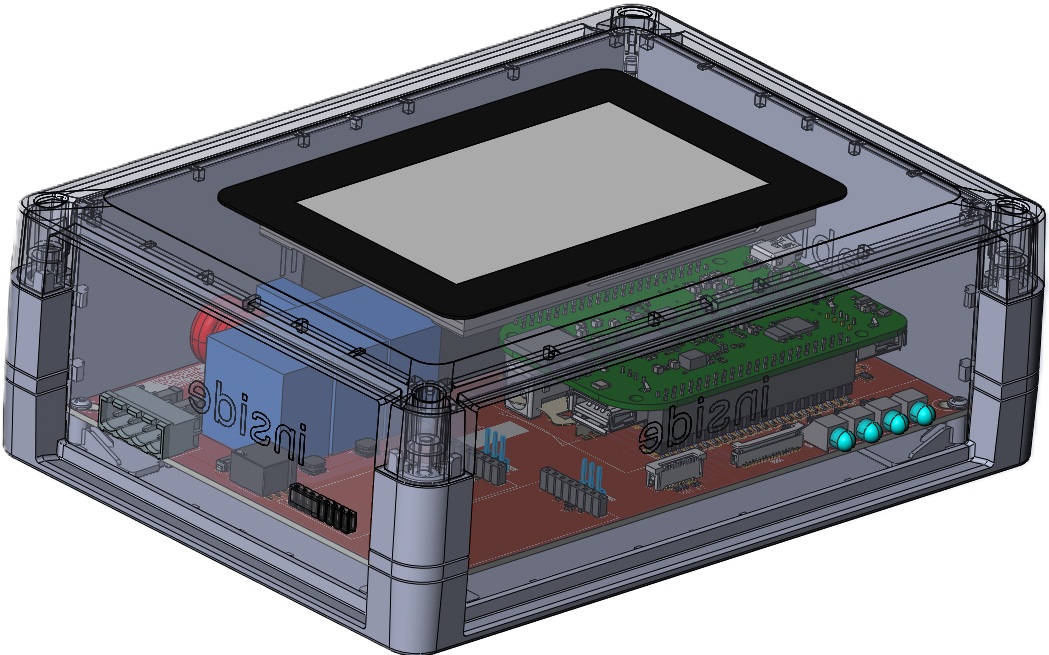
ARG Industrial Edge
One gateway. Every protocol.
The DC3 bridges legacy industrial devices to modern cloud platforms over any available medium, cellular, Wi-Fi, G3-PLC power-line mesh, or Modbus TCP/IP. It powers directly from the AC line (80‑480 VAC, 15 VA), mounts on a standard 35 mm DIN rail, and connects to ARG Cloud via MQTT with no network infrastructure required.
Capabilities
Everything a field-hardened gateway needs.
The DC3 is designed for installations where network access is unreliable, power infrastructure is industrial, and backwards-compatibility with Modbus RTU/TCP is non-negotiable.
Cellular LTE / 4G + eSIM
Embedded eSIM + nano-SIM slot. LTE Cat-4 with automatic fallback. No SIM card provisioning required for ARG Cloud deployments.
Wi-Fi 802.11 b/g/n
2.4 GHz 802.11 b/g/n. Connects to existing facility Wi-Fi or operates as a standalone AP for local device access.
G3-PLC Power-Line Mesh
ITU-T G.9903, CENELEC-B (Europe) & FCC (North America) bands. Up to 255 nodes per cluster, 3-mile range over existing AC wiring. No new cabling required.
Modbus RTU & TCP/IP
RS-485 Modbus RTU master/slave and Modbus TCP/IP over Ethernet. Bridges legacy field devices to ARG Cloud or SCADA systems.
ARG Cloud (MQTT)
Preconfigured MQTT to ARG Cloud portal. Remote monitoring, OTA firmware updates, configurable polling intervals, and alerts.
Industrial Power Input
80‑480 VAC line powered, 15 VA. 3.75 kVAC galvanic isolation. IP40 enclosure. ‑40 to +75 °C.
Specifications
| Power Input | 80–480 VAC, 50/60 Hz, 15 VA max |
|---|---|
| Isolation | 3.75 kVAC galvanic isolation |
| Cellular | LTE Cat-4 (4G), embedded eSIM + nano-SIM slot; ARG Cloud MQTT preconfigured |
| Wi-Fi | 802.11 b/g/n, 2.4 GHz |
| G3-PLC | ITU-T G.9903 (CENELEC-B & FCC bands); 255 nodes/cluster; ∼3 mile range over existing wiring |
| Modbus | Modbus RTU (RS-485) master/slave + Modbus TCP/IP via Ethernet 10/100 |
| Ethernet | 10/100 BASE-T, RJ-45 |
| Cloud Connectivity | MQTT to ARG Cloud; also supports on-premises MQTT broker and SCADA/BMS integration |
| Operating Temperature | −40 °C to +75 °C |
| Enclosure Rating | IP40 |
| Mounting | 35 mm DIN rail |
| Standards | ITU-T G.9903, IEEE 802.11b/g/n, Modbus Application Protocol V1.1b3 |
Applications
From the panel to the cloud.
The DC3 integrates cleanly into industrial and building automation installations where the field bus is Modbus, the building has existing AC wiring, and the operations team needs cloud visibility without a network overhaul.
Industrial Automation
Aggregate Modbus RTU devices, PLCs, drives, sensors, and forward data to SCADA, MES, or ARG Cloud over cellular or Ethernet.
Building Automation
Retrofit G3-PLC mesh into commercial buildings over existing wiring. Monitor energy, HVAC, and access control with no new cable runs.
Smart Grid / Utility
Deploy a G3-PLC network across a distribution feeder. 255 nodes per cluster, up to 3 miles range, with ARG Cloud backhaul via cellular.
Remote & Harsh Sites
IP40 rated, −40 to +75 °C operation. Powers from the local AC panel. Cellular backhaul where Ethernet is unavailable.
Frequently Asked
Power Line Communication, FAQ
Straight answers to the questions we hear most about power line communication and the DC3's G3-PLC mesh.
Isn't power line communication an outdated technology?
No. PLC keeps evolving, modern standards such as G3-PLC and IEEE 1901.2 bring improved modulation, stronger security, and hybrid (PLC + RF) networking. It's a core layer in next-generation smart grids and industrial IoT, and increasingly a data backbone: it collects reliable data from distributed devices that AI and analytics platforms use for predictive maintenance, grid optimization, and anomaly detection.
Aren't power lines too noisy for reliable communication?
Power lines are noisy, but modern PLC is built for that environment. OFDM modulation, forward error correction (FEC), interleaving, and adaptive tone mapping keep communication robust even under severe noise.
Will PLC disturb my power supply or connected equipment?
No. PLC uses low-power, high-frequency signals superimposed on the line, negligible next to the power itself. They're designed to coexist with power delivery, are filtered and coupled to avoid affecting equipment, and comply with EMC standards. A properly designed PLC system doesn't affect power quality or supply stability.
Isn't PLC too slow, suitable only for low data rates?
PLC isn't inherently slow, it's tuned to the application. Narrowband PLC runs from kb/s to hundreds of kb/s, mid-band reaches Mb/s, and broadband up to roughly 1 Gb/s. Standards like G3-PLC and IEEE 1901.2 deliver hundreds of kb/s, plenty for advanced metering, firmware updates, and real-time grid control, where determinism matters more than peak throughput.
Isn't wireless always the better choice?
Not for systems already connected to power. Wireless wins on mobility, but PLC offers deterministic coverage, any device on the line can be reached, without coverage gaps, spectrum congestion, or dependence on external infrastructure. The DC3 carries cellular, Wi-Fi, and G3-PLC on one device, so you use the right medium for each link.
Can I just use a wireless modem on the power line?
No. The power-line channel is fundamentally different from RF, periodic noise synced to the AC cycle, frequency-selective attenuation, impedance swings, and impulse noise from motors, relays, and switching. Reliable PLC needs a PHY layer purpose-built for that channel, not a wireless modem adapted to it.
Is PLC only useful for smart meters?
Metering (AMI) is common, but PLC also serves street lighting, industrial automation, EV charging, transportation, and renewable energy. Modern narrowband PLC supports IPv6 (6LoWPAN), mesh routing, and strong security, making it a general-purpose technology for large-scale, mission-critical infrastructure.
Is PLC secure?
Yes. Modern PLC standards include AES encryption (128/256-bit), authentication, secure key management, and controlled device provisioning. As a wired medium it also avoids over-the-air exposure, requires physical access to tap, and reduces the risk of jamming, spoofing, or RF-based attacks, a strong fit for critical infrastructure.
Is PLC difficult to deploy?
Usually the opposite. PLC reuses existing electrical wiring, no trenching, no new cable runs, no wireless site surveys or spectrum planning. With minimal added hardware, deployment is faster and total cost is lower.
Does PLC scale to large deployments?
Yes, up to millions of nodes across mesh and hierarchical topologies with utility-grade management. ARG's G3-PLC (ITU-T G.9903, CENELEC-B / FCC) supports 255 nodes per cluster with roughly 3-mile range over existing wiring, and clusters combine for wider coverage.
Is PLC future-proof?
PLC is becoming core to long-term grid architecture. Modern standards (G3-PLC, IEEE 1901.2) are IPv6-based (6LoWPAN), built for interoperability and long lifecycles, and still evolving toward hybrid PLC+RF and higher performance. PLC networks already support DER integration, EV charging, and AI-driven grid analytics.
Adapted from “11 Myths About Power Line Communication (PLC)” by Zeev Collin, Semitech Semiconductor, Electronic Design, July 2026.
Ready to deploy the DC3?
Contact us for pricing, integration support, and OEM options.